
Five Christmas markets in eight days sounds like a lot until you look at the train map. Nuremberg, Regensburg, Munich, Salzburg and Vienna sit on one line running southeast, and none of the legs between them is longer than about two and a half hours. You can do the whole thing without a car, without a flight and without ever checking out before breakfast.
This is the route we would hand a friend who asked for it: which order, which dates, how long in each city and where people usually lose time. The dates below are the 2026 dates published by the markets themselves, so check them against your plans before you book anything.
Why a Christmas market trip works so well by train
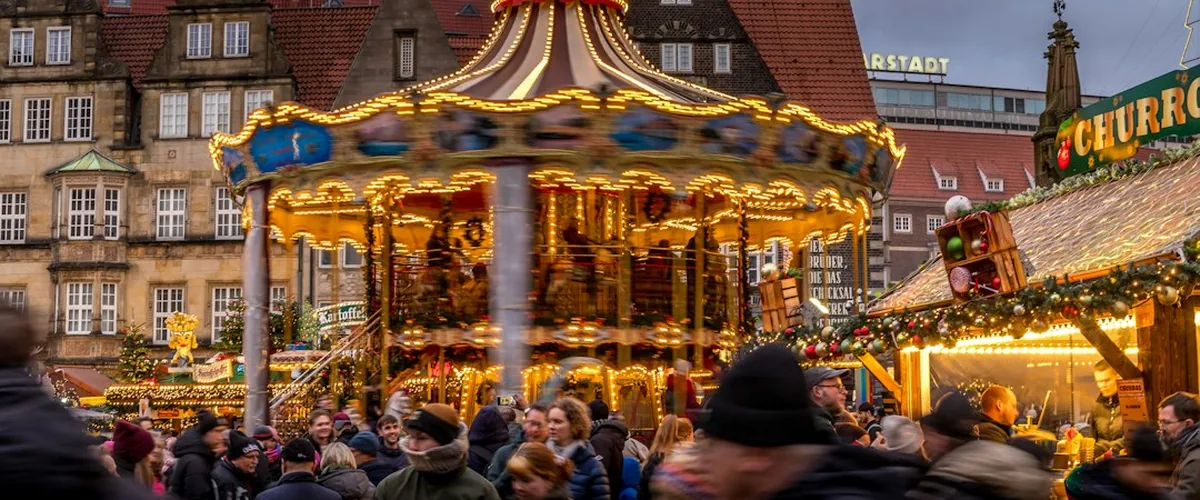
The big markets sit in old town squares, and old town squares sit a short walk or tram ride from the main station. That is the whole argument. Driving means parking garages at holiday prices and a designated driver who cannot touch the mulled wine. Flying between cities this close means more time in airports than on the train itself.
The other reason is daylight. In early December the sun sets around 4 pm in Vienna and only a little later in Munich, so the afternoon goes fast. A two-hour train ride after lunch costs you very little, because the markets only get their atmosphere once the lights come on. Travel at midday, arrive at dusk, walk straight into the market. That rhythm runs through the whole itinerary.
If you are still choosing between cities rather than planning a route, our guide to the best Christmas cities in Europe covers that question. This post assumes you want several markets in one trip.

Pick your dates first: the market calendar for 2026
Every market keeps its own calendar, and the one that opens last decides when your trip can start. Here is what the organizers have published for 2026:
| Market | 2026 dates | Daily hours |
|---|---|---|
| Nuremberg Christkindlesmarkt | Nov 27 to Dec 24 | 10 am to 9 pm (Dec 24: until 2 pm) |
| Salzburg Christkindlmarkt (Domplatz) | Nov 19 to Jan 1 | Roughly 10 am to 8:30 pm, later on Fri and Sat |
| Vienna Christmas Market (Rathausplatz) | Nov 13 to Dec 26 | 10 am to 10 pm (Dec 24: until 6:30 pm) |
| Munich (Marienplatz) | Usually late November to Dec 24 | Check the city’s listing closer to the date |
| Regensburg (several markets) | Usually late November to just before Christmas | Varies by market |
Sources: the Nuremberg Christkindlesmarkt, the Salzburg Christmas Market and the Vienna Christmas Market official sites.
Nuremberg is the bottleneck. It opens on Friday, November 27, with an opening ceremony at 5:30 pm, and closes at 2 pm on Christmas Eve. So the realistic window for all five cities is November 27 to about December 22. Inside that window, two things are worth knowing.
- Weekdays are a different experience. On a Saturday evening the Nuremberg market is shoulder to shoulder, and you will spend more time in the queue for a Bratwurst roll than eating it. Plan the two biggest markets, Nuremberg and Vienna, for weekdays if you can.
- December 8 is a public holiday in Austria. Shops are mostly open and the markets get extremely busy with day-trippers. Salzburg even publishes separate opening hours for December 7 and 8. If your trip crosses that date, put yourself in a German city for it.
Our post on Sundays and public holidays in Europe explains what closes on those days, which matters more in Germany and Austria than almost anywhere else.
The route: Nuremberg to Vienna in eight days
Run the route from northwest to southeast. Most travelers from North America land in Frankfurt or Munich, and Frankfurt to Nuremberg is a straightforward ICE ride. At the other end, Vienna has a large airport with plenty of direct flights home. That way you never retrace a leg.
Nuremberg: 2 nights
Start with the most famous one while your energy is high. The Christkindlesmarkt fills the Hauptmarkt square, and the official site describes it as one of the oldest Christmas markets in the world. Expect handmade decorations, Lebkuchen gingerbread and the small Nuremberg sausages served three in a roll. The market of the sister cities, with stalls from Nuremberg’s partner towns abroad, sits next door and is usually calmer.
Two nights lets you see the market once in the evening crush and once in the morning, when it is almost empty and you can actually look at the stalls. Use the daylight in between for the castle and the old town walls.
Regensburg: 1 night
Regensburg is about an hour from Nuremberg by regional train and is the stop most people skip. That is the reason to go. The old town is a UNESCO World Heritage Site, it is compact, and the markets feel built for locals rather than coach tours. One night is enough. If you want a single extra stop that changes the feel of the trip, this is it.
Munich: 2 nights
From Regensburg to Munich is roughly an hour and a half. Munich has a whole cluster of markets: the main one on Marienplatz in front of the town hall, plus smaller themed markets spread through the center. Two nights gives you one evening for the big square and one for the side markets, which tend to be more interesting.
Munich is also the most expensive stop for hotels on this route on December weekends, so book this city first.
Salzburg: 1 night
Munich to Salzburg takes about an hour and a half to two hours depending on the train. The Christkindlmarkt sits on Domplatz and Residenzplatz in front of the cathedral, and it is small enough to see properly in one evening. Salzburg’s old town is tight and very walkable, so one night is plenty unless you want a day trip into the mountains.
The Salzburg market also runs longest of the five, until January 1, which makes it the backup if your dates slip past Christmas.
Vienna: 2 nights
Salzburg to Vienna is about two and a half hours on the Railjet, and it is the most scenic leg of the trip. Vienna has more markets than you can sensibly visit. The big one on Rathausplatz in front of city hall runs from November 13 to December 26 and comes with an ice rink. The Vienna tourist board’s list covers the rest, including Schönbrunn Palace, Belvedere, Spittelberg and the Old Viennese market on Freyung.
Spittelberg is the one we would pick if you only have energy for two. It sits in narrow lanes in an old Biedermeier quarter, and the stalls lean toward crafts and local food rather than mass-made ornaments.
Trains and tickets
The route mixes German and Austrian railways, and the cheapest way to buy depends on how fixed your dates are.
- Fixed dates: book each long leg separately. Deutsche Bahn sells saver fares on intercity trains, and ÖBB does the same on the Austrian side. These are tied to one specific train, so you lose the flexibility. Cross-border legs like Munich to Salzburg can often be bought from either railway.
- Regional legs inside Bavaria: Nuremberg to Regensburg and Regensburg to Munich can be done on regional trains. Deutsche Bahn’s regional offers include day tickets that cover a whole state, and they are often cheaper than a single point-to-point fare when you are two or three people.
- Flexible dates: if you want to stay an extra night in Vienna on a whim, a rail pass is worth pricing. Interrail (or Eurail for non-Europeans) covers both countries, though seat reservations are extra on some trains. Our Interrail routes post explains when a pass actually beats single tickets.
Saver fares get more expensive as December fills up. Our guide on when to book flights and trains in Europe has the booking-window logic, but the short version for this trip is to buy the long legs as soon as your dates are fixed.
What the trip costs, roughly
We are not going to quote prices that change by the week, but the cost structure is predictable enough to plan around.
- Hotels are the big number. December weekends in Munich and Vienna are expensive and fill early. Nuremberg on the opening weekend is the same. Regensburg and Salzburg midweek are usually the cheapest nights of the trip.
- Trains are the small number if you book early or use regional day tickets, and the most painful one if you buy flexible fares at the station.
- The markets themselves are free to enter. What adds up is food and drink. Mulled wine comes in a deposit mug, and you get the deposit back when you return it. Keep the mug if you collect them; most people end up with one from each city.
- Carry some cash. Card acceptance at stalls has improved a lot, but small food stands are still the place where a card terminal is missing or offline. Our post on money in Europe covers which cards avoid foreign transaction fees.
Where the trip usually goes wrong
Booking the 23rd onward. Nuremberg closes at 2 pm on the 24th and Vienna closes early that day too. Families take over the cities from the 23rd, and some trains sell out. Finish the route by the 22nd if you can.
Too many one-night stops. Five cities in five nights means packing every morning and arriving at every market tired. The eight-night version above has three two-night stops for a reason. If you only have six nights, cut Regensburg rather than shortening Nuremberg or Vienna.
Dragging a big suitcase over cobblestones. Old towns and wheeled luggage do not get along, and train stations in December are crowded. Pack light, or if you arrive before check-in, our luggage storage guide lists the options near main stations.
Ignoring pickpockets. Crowded markets after dark are exactly where they work. Keep your phone in a front pocket and your bag zipped. Our post on pickpockets and tourist scams has the details.
Planning outdoor sightseeing for the late afternoon. By 4:30 pm it is dark. Do castles, viewpoints and walks in the morning, travel at midday and keep the evenings for the markets.
A shorter version: five nights, four cities
If you only have a long weekend plus a couple of days, drop Regensburg and spend one night each in Salzburg and Munich:
- Nuremberg, 1 night (arrive by early afternoon, market in the evening).
- Munich, 1 night.
- Salzburg, 1 night.
- Vienna, 2 nights.
It works, but you will see Nuremberg only in the evening crowd. If Nuremberg is the reason you are going, give it two nights and drop Munich instead.
Put the market hours into the plan
A route like this has a lot of small moving parts: five markets with different opening dates, trains that are cheaper on some days than others, and a holiday in the middle of December that changes how busy Austria is. That is easier to manage written down than remembered. Build the route in Lentii, add each city’s market hours and your train times to the right day, and share the plan with whoever you are traveling with. When someone suggests adding a day in Vienna, you will see right away which train booking it affects.
FAQ
What is the best route for a Christmas market train trip in Germany and Austria?
Nuremberg, Regensburg, Munich, Salzburg and Vienna, in that order. The cities sit on one rail line, no leg is longer than about two and a half hours, and you never have to backtrack. Eight nights is a comfortable length.
When should I go to see all the markets open?
Between November 27 and about December 22 in 2026. Nuremberg opens last, on November 27, and the markets start closing on Christmas Eve. Weekdays are much less crowded than weekends.
Do I need a rail pass for this trip?
Not usually. If your dates are fixed, saver tickets booked early are often cheaper than a pass, and regional day tickets work well for the Bavarian legs. A pass makes sense if you want the freedom to change your plans as you go.