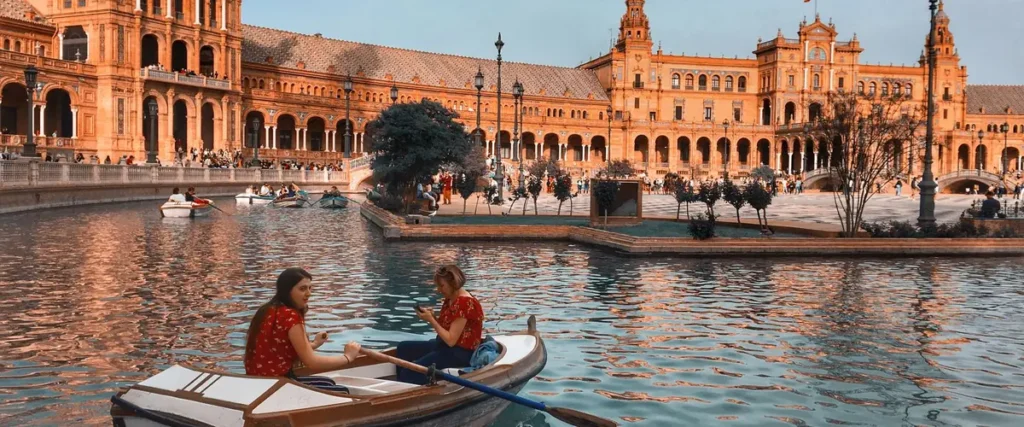

Food is the line in a travel budget that moves the most, and it moves for reasons that have almost nothing to do with how well you eat. Two people can spend a week in Seville, eat the same number of meals, and come home €200 apart. The difference is rarely willpower. It is knowing that lunch and dinner are priced on different logic, and that most of Europe quietly rewards anyone who figures that out.
This is the practical version: the fixed-price lunch, how markets actually work, what a supermarket dinner looks like when you do it properly, and the small charges that turn a cheap meal into a medium one.
The fixed-price lunch is the whole trick
Across southern Europe, restaurants serve a set midday meal for working people at a price they would never charge in the evening. Same kitchen, same dining room, sometimes the same dishes. The menu is short, it is rarely translated, and it is often written on a chalkboard by the door rather than printed.
Spain’s menú del día is the best known, and the habit is strong enough that skipping it in a provincial city feels conspicuous. Italy’s menù di lavoro or pranzo di lavoro does the same job near offices and markets. France runs a formule midi, usually two courses with a glass of wine. Portugal’s prato do dia is a single plate at a price that still surprises people.
| Country | What to ask for | Typically includes | Rough price |
|---|---|---|---|
| Spain | Menú del día | Starter, main, bread, drink, dessert or coffee | €12–18 |
| Italy | Menù di lavoro | Primo or secondo, water, sometimes coffee | €10–16 |
| France | Formule midi | Two courses, often a glass of wine | €14–22 |
| Portugal | Prato do dia | One generous plate, bread, sometimes soup | €8–13 |
| Germany, Austria | Tagesmenü / Mittagsangebot | Soup and a main, or a main and a drink | €10–16 |
| Nordics | Dagens ret / dagens lunch | Buffet or plated main, bread, coffee | €12–20 |
| Poland, Czechia, Hungary | Lunch menu / denní menu | Soup and a main | €6–10 |
Two rules make this work. The first is timing: the fixed menu runs during a narrow window, roughly 12 to 3 in Spain and Portugal, earlier in northern Europe, and it ends when it ends. The second is that you have to ask. Plenty of places will hand a tourist the evening card by default and the day menu only if you say the words.

Flip the day: big meal at midday
If lunch is the good-value meal, the sensible move is to make it the main one. Eat properly at one, then treat the evening as something small. That single swap changes a food budget more than any amount of hunting for cheap restaurants, because it moves the expensive meal into the cheap slot rather than trying to make the expensive slot cheap.
It also fits how these countries eat. Spanish and Italian dinner runs late, and the places serving at 7pm are mostly serving visitors. Arriving at nine means eating where locals eat, at a table that was not set aside for the early crowd, though your appetite may have other ideas after a big lunch.
For the evening, the options that cost little and still feel like something: a few tapas standing at the bar, a plate of cheese and ham from a deli eaten at the apartment, a bakery pastry and a walk. In Italy, the northern aperitivo tradition puts out a spread of food with a drink for a fixed price, which in Milan or Turin can do the work of dinner for the price of a cocktail.
Markets, and the two hours that matter
Every guidebook says visit the market. Fewer mention that a market has two entirely different personalities depending on when you walk in.
Mid-morning is the tourist version: the stalls nearest the entrance sell juice in plastic cups, pre-cut fruit at four times the going rate, and paella by the scoop. Walk past them. The produce, cheese, fish and charcuterie stalls are deeper in, and they are the reason to be there. The last hour before closing is the other window, when stallholders discount what will not survive to tomorrow.
What to buy: bread, a cheese, cured meat, olives, tomatoes, fruit. Roughly €10 to €15 gets two people a good lunch or a solid evening spread. Many markets also have a counter kitchen cooking what the stalls sell, which is usually both cheaper and better than the restaurants ringing the square outside. Berlin’s Markthalle Neun runs weekly market days built around exactly that, and Lisbon and Spain’s tourist boards list which city markets still function as food markets rather than food courts. Italy’s tourism site keeps a regional food guide worth skimming before you pick a city to eat in.
The supermarket dinner, done properly
There is a version of this that is grim, and it involves a packet of crisps and a bad sandwich. The good version takes ten minutes and costs about €6 a head.
- Go to the supermarket the locals use. Mercadona, Lidl, Coop, Biedronka, Continente. The convenience store by the station charges a premium for being there.
- Buy the counter items. Most European supermarkets have a deli, cheese and often a fish counter where the price is close to market price. That is where the meal is.
- One thing that needs no preparation, one that feels like cooking. A rotisserie chicken, a good bread, a tub of olives, tomatoes with salt and oil. You need a knife, which the accommodation usually has.
- Check the discount shelf. Near-date items are marked down late in the day, often heavily. Pastries and prepared food go first.
Do this two evenings in a week and you have paid for a proper restaurant meal on the third. Doing it every night is where budget travel starts to feel like a chore, and it is not necessary.
The charges that inflate a cheap meal
A €12 plate can arrive as a €22 bill without anyone doing anything wrong. The additions are legal and mostly disclosed, just not prominently.
- Italy’s coperto. A per-person cover charge, commonly €1.50 to €3. It should be printed on the menu. Some tourist-area places also add a service percentage on top.
- Spain and Portugal’s couvert. The bread, olives or paté that appears without being ordered is usually chargeable. Waving it away is normal and not rude.
- Terrace pricing. In parts of Italy and France the same coffee costs more at an outside table than standing at the bar, sometimes double. This is posted, in small type.
- Water. Bottled water is a line item almost everywhere. Tap water is drinkable across most of Europe and free to ask for in France, less customary in Italy and Spain.
- The “tourist menu”. Different beast from the day menu: printed in four languages, photographed dishes, positioned on the main square. It is priced for people who will not come back.
Prices have to be shown clearly before you order, and the EU’s consumer pricing rules cover what that means in practice. If a charge is not on the menu, it is fair to query it. Paying by card adds its own wrinkle, since being asked whether to charge in your home currency is where the real money leaks out, and our guide to cards and fees in Europe explains why the answer is always no.
The price cliff is about four streets
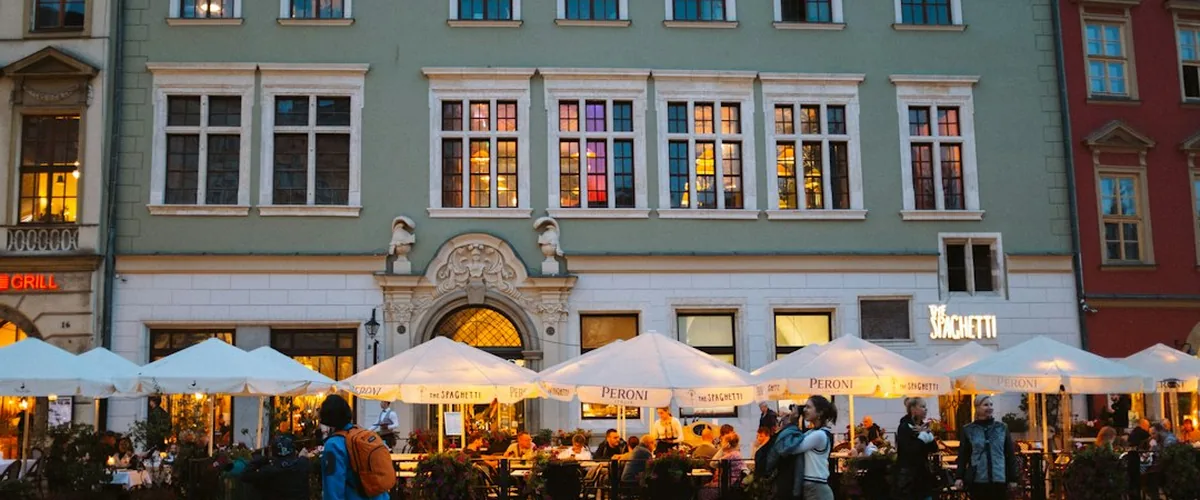
The most reliable rule in European city eating: walk away from the monument. Prices fall sharply within a few hundred meters of the main square, and quality tends to move the opposite way. Four or five streets back is usually enough. If a place has a menu in five languages and someone outside inviting you in, you have not walked far enough.
Two other quick signals. A handwritten or chalkboard menu means the kitchen changes what it cooks, which is a good sign. A full room at the local eating hour matters more than any review score, because locals will not pay tourist prices in their own neighborhood.
What a day actually costs
Three ways to eat through the same day, per person, in a mid-priced European city.
| Approach | A typical day | Daily total |
|---|---|---|
| Market and supermarket | Bakery breakfast, market lunch, supermarket dinner | €10–15 |
| Day menu at midday | Coffee and pastry, fixed-price lunch, light evening plate | €22–30 |
| Restaurant dinners | Café breakfast, café lunch, sit-down dinner with wine | €45–70 |
Most people are happiest somewhere between the first two rows, with one deliberate meal in the third. Across a week that lands near the middle row on average, and it is the difference between a food budget of €150 and one of €400. Which cities sit at the cheap end of those ranges is its own question, and our list of affordable European cities is a decent starting point.
Build it into the days, not the good intentions
Eating well for little in Europe comes down to three small habits: take the fixed-price lunch where it exists, treat the market as a meal rather than a photo stop, and know which charges are optional. None of it requires eating badly.
The part that actually slips is the timing. If the day menu ends at 3 and you are on the other side of town at 2:40, you are paying evening prices. Put the meal in the plan like a stop: build the day in Lentii, mark where lunch happens and roughly when, and let the sightseeing arrange itself around it. Pair it with the free things worth doing in the same neighborhood and the day costs almost nothing beyond the meal. Our broader travel food guide covers the eating-well side, and the day trips guide is where the small-town versions of all this are cheapest.
FAQ
How much should I budget for food per day in Europe?
Between roughly €10 and €15 a day if you shop at markets and supermarkets, €22 to €30 if you take a fixed-price lunch and eat lightly in the evening, and €45 or more once dinner is a restaurant meal with wine. Eastern and southern Europe sit at the low end of each band, the Nordics and Switzerland well above.
Is the menú del día available to tourists?
Yes. It is a standard midday offer, not a local-only arrangement. Ask for the menú del día by name when you sit down, since a lot of places hand visitors the regular card by default.
Do I have to pay the cover charge in Italy?
If the coperto is printed on the menu, yes, it is a legitimate charge and applies per person. What is optional is the bread and nibbles brought to the table in Spain and Portugal, which you can decline before they are opened.