
Most trips to Europe end without anything going missing. The ones that don’t usually follow a pattern: a crowded metro carriage, a stranger with a clipboard, a phone left on a café table by the door. Pickpockets in Europe are rarely violent and rarely clever. They count on you being tired, distracted and carrying everything in one place.
This guide covers where petty theft and tourist scams actually happen, the handful of tricks that come up again and again, and a simple setup that means a lost wallet costs you an afternoon instead of the trip.
Where pickpockets in Europe actually work
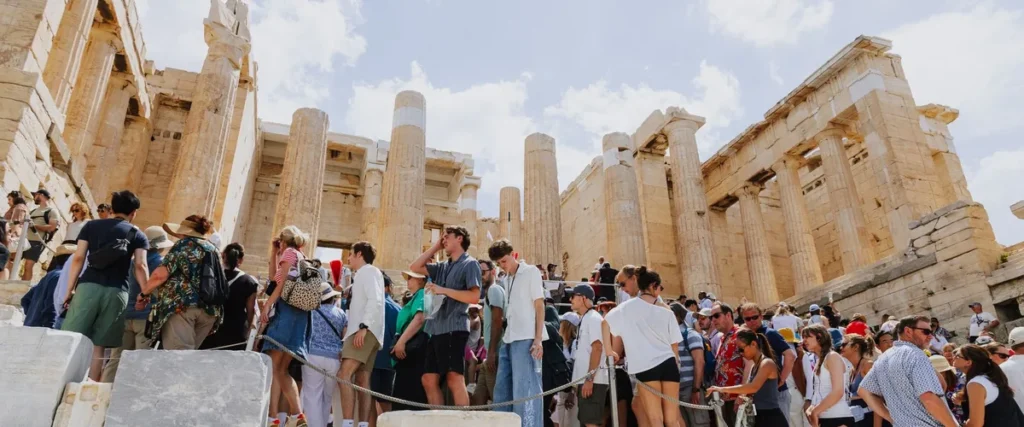
Theft clusters around movement and crowds. Thieves want a target who is busy with something else and a crowd to disappear into. That points to the same few places in almost every big city.
- Metro and tram lines that serve the sights. The UK government’s travel advice names the Paris Métro, the RER lines and the mainline stations as places where thieves operate. For Prague it points to the airport bus and metro route into the center and the trams up to Prague Castle.
- Airport arrivals and train stations. You have bags, a phone out for directions and no idea where you are. Spain’s advice specifically mentions theft while collecting luggage at the airport and while arranging car hire.
- The famous squares and the streets between them. Think of the stretch from Barcelona’s Plaça de Catalunya down to the port, the area around the Trevi Fountain in Rome, or Dam Square in Amsterdam. Lots of people looking up and taking photos.
- Café and terrace tables. A phone on the table near the pavement is the easiest grab in Europe. Someone puts a map or a menu on top of it, asks a question, and leaves with both.
- Night trains and long-distance buses. Less common, but bags stored overhead or at the end of a carriage are out of sight for hours.
Italy’s advice puts it plainly: crime is generally low, but bag snatching and pickpocketing are higher in city centers and at major tourist attractions. That is a fair summary of the whole continent.

The tricks that come up again and again
Scams change their costume, but there are only a few basic moves. Once you know them you start seeing the setup before it starts.
The distraction team
One person creates a moment, another does the taking. Someone bumps into you, drops coins at your feet, spills something on your jacket and offers to clean it, or asks you to sign a petition. While you deal with that, a second person goes into your bag or pocket. France’s travel advice describes exactly this: one distracts you while the other goes into your bag. The fix is simple. When a stranger suddenly needs your attention, put a hand on your bag first and deal with them second.
The fake police officer
Two men in plain clothes show a badge and ask to check your wallet for counterfeit notes or “drug money.” They hand it back a little lighter. Spain’s advice warns about thieves posing as police who ask to see your wallet for identification. Real officers in Europe do not inspect tourists’ cash on the street. Offer to walk with them to the nearest police station, or show a photocopy of your passport and keep your wallet away.
The friendship bracelet and the free rose
Someone ties a string bracelet on your wrist or presses a flower into your hand, then demands money and makes a scene if you refuse. It shows up near Montmartre in Paris and around big monuments in Rome and elsewhere. Keep your hands in your pockets, say no, and keep walking. Don’t stop to argue.
The street money changer
Outside the eurozone, someone offers a better rate than the exchange office. You get notes that are worthless, out of circulation or from another country. Prague police advise changing money at an exchange office or bank, never on the street. In practice you rarely need cash at all. Our guide to money in Europe, cards and cash covers when you actually need it and how to get it without the fees.
The taxi and the bar bill
Unmarked taxis at airports and stations that “forget” the meter, and nightclubs or bars that hand you a consumption card and then charge a fortune for losing it. The Czech advice flags both. Use the official taxi rank or a ride app, and ask the price of drinks before you order in places that feel like they’re working a little too hard to get you inside.
The helpful stranger at the ticket machine
You’re struggling with a metro ticket machine and someone steps in to help. They either watch your PIN, swap your card, or sell you a used ticket. Ticket machines in most cities have an English option, and staffed windows exist for a reason. If you’d rather skip the machines entirely, a city transport pass bought in advance or tapping in with a contactless card removes the problem.
Common scams at a glance
| Trick | Where it shows up | What to do |
|---|---|---|
| Bump, spill or dropped coins | Metro platforms, escalators, busy streets | Hand on your bag first, then react |
| Petition or survey clipboard | Outside big monuments | Don’t stop, don’t sign |
| Fake police wallet check | Quiet side streets in tourist areas | Offer to go to the police station |
| Bracelet or flower “gift” | Hilltop viewpoints, church steps | Hands away, keep walking |
| Street money exchange | Non-euro cities like Prague and Budapest | Use a bank or ATM |
| Phone grab from table | Terraces and cafés by the street | Phone in a pocket, not on the table |
| Unmetered taxi | Airports and main stations | Official rank or ride app only |
A setup that makes theft a small problem
You can’t make yourself impossible to rob. You can make sure that whatever gets taken is not everything. Most of the bad stories start with one bag that held the passport, both cards, the phone and the cash.
- Split your money. Carry one card and a little cash on you for the day. Leave a second card, from a different bank if you can, in the hotel safe or locked in your main bag.
- Leave the passport behind on city days. Unless you’re crossing a border or the country requires you to carry ID, keep it in the room and carry a photo of it on your phone plus a paper copy.
- Use a bag that closes and sits in front. A crossbody bag with a zip, worn to the front on the metro, beats a backpack with an open outer pocket. Spain’s and France’s advice both suggest carrying bags across the body.
- Front pocket for the phone, never the back. And not on the table, not in a jacket hanging on the chair.
- Turn on your phone’s find-and-lock feature before you go. Write down your phone’s IMEI number and keep it somewhere other than the phone.
- Save your bank’s international number. The number on the back of the card is no use once the card is gone.
- Don’t carry what you won’t use. If you’re checking out at noon and catching a train at six, put the big bag in luggage storage instead of dragging it around the old town, where it marks you as a tourist with everything on you.
How to look like less of a target
You don’t need to dress like a local. You need to look like someone who knows where they’re going and is paying attention. A few small habits make a real difference.
Check the map before you leave the station, not in the middle of the exit hall. Step to the side of the pavement when you need your phone. On escalators and at metro doors, which is where the crush happens, hold your bag rather than your phone. At a café, loop the bag strap around your leg or the chair leg.
Timing matters too. The same square that feels relaxed at 8:30 in the morning is packed by 11:00, and thieves follow the crowds. Planning the busiest sights for early in the day helps with both the queue and your pockets.
And trust the odd feeling. If someone is standing too close on a half-empty platform, or a group seems to be moving with you through the station, move to another carriage or wait for the next train. You lose two minutes.
If something does get stolen
Do things in this order, and do the first two within the hour.
- Block your cards in your banking app, or call the bank. Then change the password on your email if your phone went too, since your email is the key to everything else.
- Lock and locate the phone from another device, and call your mobile provider to block the SIM.
- Report it to the police and get a written report. You’ll need it for any insurance claim and often for a replacement passport. In Spain, the police app AlertCops lets you report a crime in English. In Prague, the UK advice says to report within 24 hours to get a police report, and lists the 24-hour station at Jungmannovo náměstí 9 with English-speaking interpreters. Across the EU, 112 is the emergency number in every country.
- Contact your embassy or consulate if your passport is gone. Most can issue an emergency travel document, sometimes within a day.
- Start the insurance claim the same day while details are fresh. Check what your policy covers before you travel, because many have low limits for cash and require a police report within a set time. Our guide to travel insurance in Europe explains what is usually covered and what isn’t.
Check the official advice for your destination
Government travel advice is dull reading but it’s specific, updated and free. The UK’s pages for Spain, France, Italy and Czechia list the local tricks, the transport lines to watch and how to report a crime. Spend five minutes on the page for each country on your route before you leave.
Put it in the plan, then forget about it
Most of this is a one-time setup. Split the cards, photograph the passport, save the bank’s number, turn on phone tracking. After that you can stop thinking about it and enjoy the trip. When you build your route in Lentii, you can add notes to each stop, so the reminder to leave the passport in the safe on city days or to take the official taxi from the airport sits right next to the day it applies to, and it’s there for everyone you share the plan with.
FAQ
Which European cities have the most pickpockets?
Theft follows tourist crowds, so the big, busy cities come up most often: Barcelona, Paris, Rome, Prague and Amsterdam among them. Within any city, the risk is highest on metro lines to the sights, at main stations and around the most photographed squares.
Is a money belt worth it?
For most city trips, a zipped crossbody bag worn in front does the job and is easier to use. A money belt makes sense for carrying a backup card and passport on travel days, as long as you don’t open it in public.
What should I do if someone claiming to be police asks for my wallet?
Don’t hand it over. Ask to see their ID properly and offer to go with them to the nearest police station. Genuine officers will accept that. People running the scam usually leave.