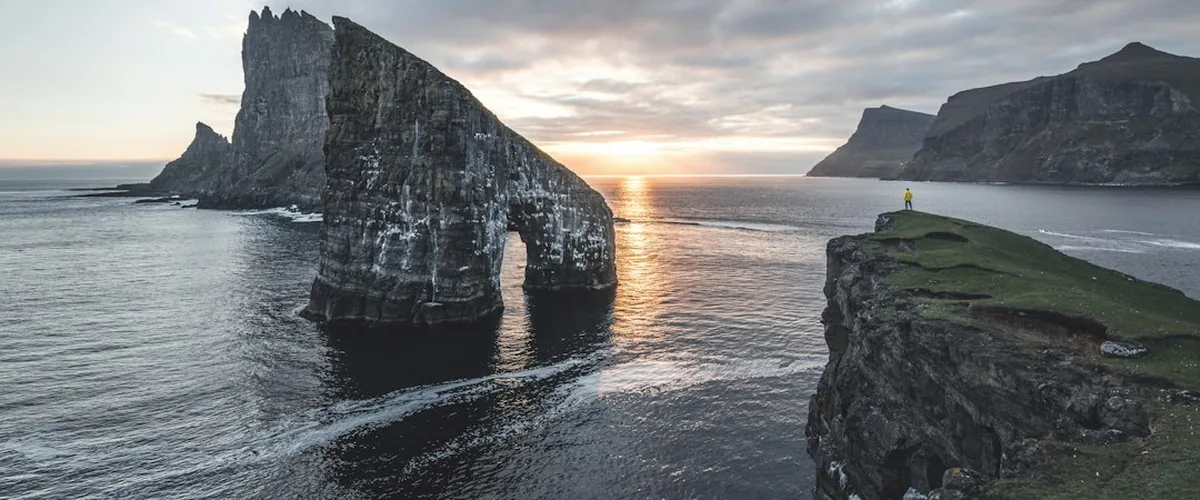
The Faroe Islands look small on a map, eighteen islands between Iceland and Norway, and that is exactly why people underplan them. Five days is a good length. It is enough to see the cliffs, the turf-roofed villages and one boat trip, as long as you decide early where you sleep and how you move between islands.
This guide covers both questions. It gives you two ways to base yourself, a day-by-day plan that works with or without a car, and the fees that catch first-timers out at the trailhead or the tunnel mouth.
Getting there: one airport, one ferry
Almost everyone arrives at Vágar Airport, the only airport in the islands. Atlantic Airways, the Faroese carrier, flies there from Copenhagen, Billund and Aalborg year-round, and also serves cities such as Edinburgh, Oslo, Reykjavík and Paris. Copenhagen has the most departures, so it is usually the easiest connection from elsewhere in Europe.
The slow option is the Smyril Line ferry Norröna from Hirtshals in northern Denmark to Tórshavn. The crossing takes around 30 hours in summer and 38 in winter, and it carries cars. It makes sense if you want your own vehicle for a long stay. For a five-day trip, the two days at sea eat too much of the week. Check current sailings on Smyril Line’s site, because the timetable changes between seasons.
The airport sits on the island of Vágar, about 50 minutes by road from Tórshavn. That distance shapes the whole plan, because some of the best short hikes are right next to the runway.

Where to base yourself
You have two sensible setups. Which one fits depends almost entirely on whether you rent a car.
Option 1: Tórshavn for all five nights
The capital is the hub of the bus network. Every main route either starts there or connects there, it has the widest choice of places to eat, and the red city buses inside Tórshavn have been free since 2019. If you are traveling by public transport, staying put here is the simplest choice by a distance. You will repeat the airport road once or twice, but you avoid packing up every other morning.
Option 2: Split between Vágar and the north
With a car, a split stay saves driving. Spend the first two nights on Vágar, near Sørvágur or Miðvágur, which puts you minutes from the Trælanípa hike and the Mykines boat. Then move for three nights to Tórshavn or to Eysturoy, where villages like Gjógv put you close to the northern islands. Gjógv is beautiful and very small, so book early and expect very few places to eat.
If your budget is tight, look at what a week in the region costs before you commit. Our breakdown of what a week in the Nordics actually costs gives a useful baseline. The Faroes sit at the expensive end of that range, especially for accommodation.
Car or bus? The honest comparison
The bus network, run by Strandfaraskip Landsins (SSL), covers more than most visitors expect. It also has gaps, and on the quieter routes buses may run only a few times a day. Here is how the two choices stack up for a five-day trip.
| Factor | Bus and ferry | Rental car |
|---|---|---|
| Main cost | Tourist Travel Card: DKK 500 for 4 days, DKK 700 for 7 days | Daily rental plus fuel and tunnel tolls |
| Airport to Tórshavn | Route 300, about 50 minutes, 6 to 10 departures a day | About 50 minutes, whenever you like |
| Gjógv and the north | Possible with a change, low frequency | Easy |
| Saksun and remote valleys | No direct bus | Easy, single-track roads in places |
| Weather flexibility | Low, you follow the timetable | High, you can swap days around |
| Best for | Solo travelers, a Tórshavn base | Couples, groups, photographers |
The travel card covers SSL buses and ferries, including the boat to Kalsoy. It does not cover the Mykines ferry, vehicles, or anything you prebook. You can buy it at the airport information desk, the ferry terminal in Tórshavn, or on the route 300 bus. Prices and what the card includes are listed on SSL’s tourist travel card page. One practical warning: on most buses you still need cash for single tickets. Route 300 is the exception and takes cards.
If you go with a car, read our guide to the costs nobody quotes you when renting a car in Europe. In the Faroes, the hidden line item is tunnels.
The tunnel tolls, explained once
The islands are linked by subsea tunnels, and four of them charge a toll. According to the official tunnel company, a regular car pays DKK 175 one way through Eysturoyartunnilin (Streymoy to Eysturoy) and the same through Sandoyartunnilin (Streymoy to Sandoy). The older Vágar and Norðoy tunnels cost DKK 50, collected on the way back, so about DKK 100 for a return trip.
Cameras read your plate, so there is no booth. If you rent locally, you pay the rental company, not the tunnel company, and some companies charge more than the official rate or sell a multi-day tunnel pass instead. Ask at the counter which tunnels the pass includes. For Eysturoy there is a free way around: a bridge links it to Streymoy, so you only need the tunnel in one direction if you are happy with a longer drive.
A five-day plan
This plan assumes a morning or midday arrival on day one. Treat the order as loose. The weather changes fast here, and the smart move is to keep the most exposed hikes for the clearest days and shuffle the rest around them.
Day 1: Land, then walk straight to the cliffs
The Trælanípa hike starts about five minutes from the airport. It runs along Lake Sørvágsvatn to the cliff edge where the lake appears to hang above the ocean, then on to the Bøsdalafossur waterfall. It takes around 45 minutes each way on a mostly gentle path. The landowners charge DKK 200 per adult to walk it without a guide, paid at the hut by the car park or through the Trælanípan site. Guided walks run three times a day.
Afterwards, head to Gásadalur for the Múlafossur waterfall dropping into the sea. It is easiest by car; by bus, check the timetable first, as departures are few. It is a short walk from the parking area and worth it in any light.
Day 2: Mykines, or Tórshavn if the boat is off
Between May and August, Mykines is the islands’ best-known day trip, mainly for the puffin colonies. The ferry leaves from Sørvágur and costs DKK 60 each way. On top of that, every visitor between 1 May and 31 August pays a hiking fee of DKK 500, or DKK 400 if you book online in advance. Visit Faroe Islands lists the current rules on its hiking fees page. The boat is small and sea conditions can cancel it, so book it early in your trip and keep a backup day.
If you are here outside summer, or the boat does not sail, spend the day in Tórshavn instead (see day 3) and move that day to the end.
Day 3: Tórshavn and Kirkjubøur
Give the capital a slow morning. Walk Tinganes, the old parliament headland with its turf-roofed wooden buildings, then the harbor. Use the free red buses to get around if your legs need a break. In the afternoon, head south to Kirkjubøur, a short hop by road, where you can see the ruins of the medieval Magnus Cathedral and one of the oldest wooden farmhouses still lived in. It is a quieter day, and you will want one by now.
Day 4: Eysturoy, Gjógv and Eiði
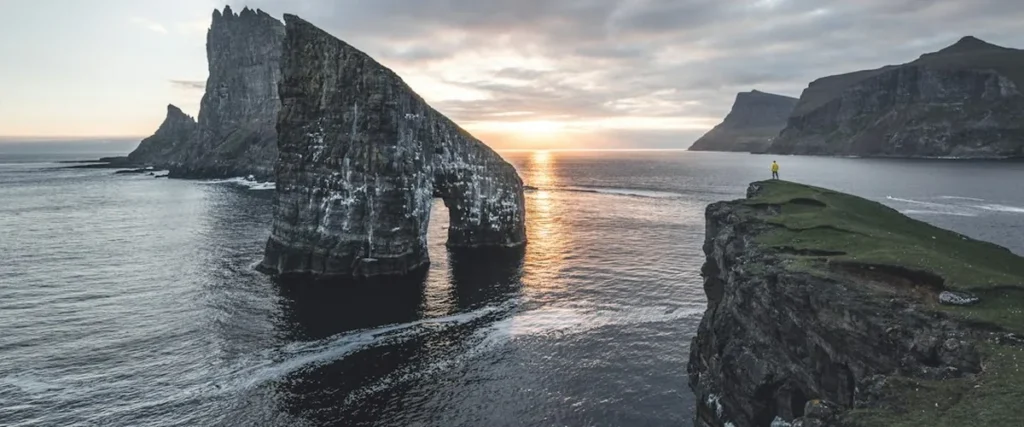
Drive north through the Eysturoy tunnel, or take the long way by the bridge. Gjógv sits around a narrow sea gorge that once served as its harbor, and the walk up the hill behind the village gives you the view you will have seen in photos. On the way, stop at Eiði for the sea stacks off the coast. Slættaratindur, the highest point in the islands at 880 meters, is a steep but short climb from the mountain road if the cloud has lifted.
By bus, Gjógv takes route 400 from Tórshavn to Oyrarbakki and then route 200. Departures on the second leg are few, so check the return times on SSL’s timetable before you set off.
Day 5: Klaksvík and the Kallur lighthouse
Klaksvík, the second town, is the jumping-off point for Kalsoy. Take the ferry from Klaksvík harbor, then bus 506 or your car up the island to Trøllanes. From there the walk to the Kallur lighthouse gives the most photographed ridge in the country. The fee is DKK 200 per adult, children aged 13 to 17 pay DKK 100, and cards are accepted on site. The path near the lighthouse is exposed, and in wind or fog it is not worth the risk. Turn around early rather than late.
If your flight leaves early on day six, sleep near Vágar the last night. The drive from Klaksvík to the airport is long enough that you do not want to do it at dawn.
When to go
Summer gives you long days, the puffins on Mykines, and the most bus departures. It also brings the most visitors and the highest accommodation prices. September is a good compromise, with fewer people and lower fees on some trails. Winter has short days and more cancellations, but it is quiet and the light can be dramatic. If you are chasing the aurora, our guide to planning a northern lights trip in the Nordics covers what actually matters for sightings.
In any season, pack proper rain gear and shoes with grip. Paths across grazing land are muddy, and the wind on the cliff edges is stronger than it looks from the car.
A few rules that save trouble
- Most hiking land is private. Fees go to the farmers who own it. Stick to marked paths and close gates behind you.
- Do not walk to the cliff edge for a photo. Turf can be undercut, and there are no railings.
- Carry some cash. Many buses still want it for single tickets. The currency is the Faroese króna, tied to the Danish krone, and Danish notes are accepted. Our guide to money in Europe covers card fees if you are coming from outside Scandinavia.
- Book dinner. Outside Tórshavn and Klaksvík, there may be only one place to eat in a village, and it may close early.
Put the plan in one place
A Faroes trip has a lot of moving parts for its size: a boat that might not sail, a bus that runs twice in the afternoon, a trail fee you need to book the day before. Build the five days in Lentii so the ferry times, trail bookings and backup day sit next to each other, and share the plan with whoever you are traveling with. If you are adding the Faroes to a bigger loop, our guide to Nordic road trip routes helps you decide where it fits.
FAQ
Can you see the Faroe Islands without a car?
Yes, if you base yourself in Tórshavn and accept some limits. The bus network and the Tourist Travel Card cover the airport, Tórshavn, Klaksvík, Kalsoy and Gjógv. Remote spots like Saksun have no direct bus, and low-frequency routes mean less flexibility when the weather turns.
Are five days enough for the Faroe Islands?
Five days covers the main highlights: Trælanípa, Gásadalur, Tórshavn, Gjógv and Kalsoy, plus Mykines in summer. Build in one flexible day, because ferries and cliff hikes depend on the weather.
How much are hiking fees in the Faroe Islands?
Fees vary by trail. Trælanípa and Kallur lighthouse each cost DKK 200 per adult without a guide. Mykines costs DKK 500 per person between May and August, or DKK 400 if booked online in advance, plus the ferry ticket. Check the official hiking fees page before you go, since rules change by season.