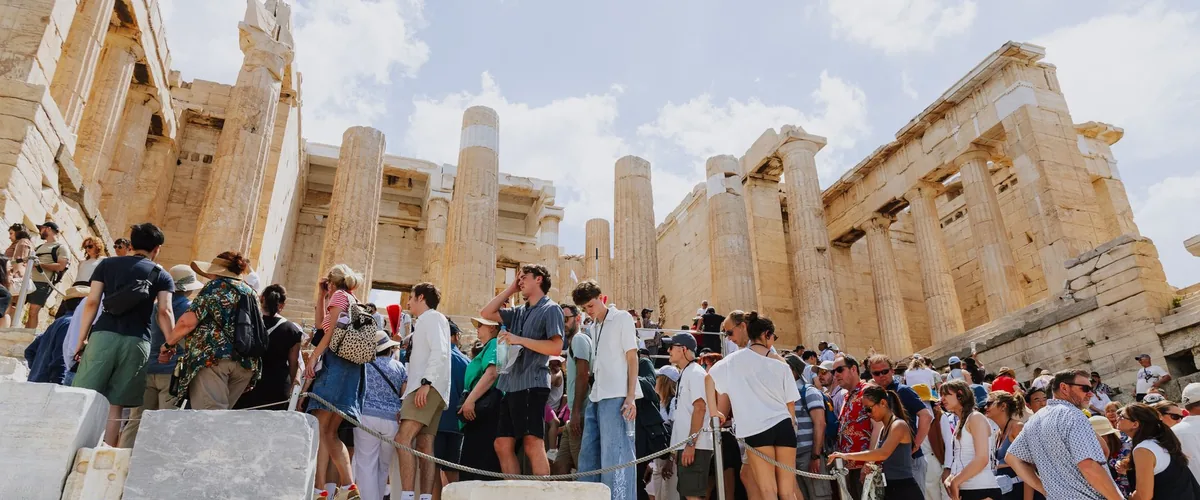

The same room in the same museum can feel like two different places depending on the hour. At 9:05 you get a clear look at the painting you came for. At 11:30 you get the back of forty heads and someone’s selfie stick. Most of Europe’s big sights follow the same daily rhythm, and once you know it, you can plan around it.
This guide is about how to avoid crowds in Europe by choosing the right time of day and the right day of the week, not only the right season. It covers the pattern that repeats almost everywhere, the specific rules at a few famous places, and how to build a day so the busiest hours land somewhere they do not hurt.
The daily crowd curve
At most major attractions, visitor numbers follow a predictable shape. It is quiet for the first hour after opening, builds fast from about 10:00, peaks between late morning and mid-afternoon, and then thins out in the last two hours before closing.
Three things drive that shape:
- Tour groups and coaches tend to arrive mid-morning, after hotel breakfast and a drive in from somewhere else.
- Cruise passengers in port cities come ashore in the morning and have to be back on board by late afternoon, so they concentrate in the middle of the day.
- Day-trippers arriving by train from a bigger city rarely get in before 10:00 and usually leave by 17:00.
So the two windows that work nearly everywhere are the first hour and the last two hours. The first hour is better for places where light and energy matter, like a cathedral or an outdoor ruin before the heat. The late window is better for big museums, where the groups have already gone and the staff are not yet clearing rooms.
| Time of day | Typical crowd | Best used for |
|---|---|---|
| Before opening to first hour | Light | The one sight you care most about |
| 10:00 to 15:00 | Heavy | Neighborhoods, markets, lunch, small museums |
| 15:00 to closing | Easing | Big museums, especially on late-opening nights |
| Sunrise and after dark | Very light | Squares, bridges, viewpoints, outdoor landmarks |

Use the late-opening nights
Many large museums stay open late one or two evenings a week, and those evenings are consistently calmer than the daytime. The Louvre is the clearest example. According to the Louvre’s own hours page, it opens until 21:00 on Wednesdays and Fridays and closes at 18:00 on other days. It is closed on Tuesdays. Last entry is an hour before closing, so on a late night you can walk in at 18:30 and still have more than two hours inside.
A Wednesday or Friday evening at the Louvre is a very different visit from a Saturday morning. Book a time slot either way. The museum recommends reserving even for visitors who get in free.
Before you plan around a late opening, check the museum’s official site for the current week. Late nights change with the season, and some are dropped in winter.
Be careful with free days
Free-entry days sound like a win, and for a local who can pop in for an hour they are. For a visitor with one shot at a place, they are often the most crowded days of the month.
The Vatican Museums are the textbook case. They open Monday to Saturday from 8:00 to 20:00, with last entry at 18:00. On the last Sunday of each month they open free from 9:00 to 14:00, with last entry at 12:30. That means a full month of demand squeezed into a few hours. Unless saving the ticket price matters more to you than seeing the Sistine Chapel in any comfort, go on a paid weekday and book through the official Vatican Museums site, not a reseller.
The Louvre’s free evening on the first Friday of the month, outside July and August, works the same way. Free is great. Free and quiet rarely happen together.
Know which places sell out, not just which get busy
At some sights, crowds are managed with timed tickets. The problem there is not a long line, it is that you cannot get in at all if you did not plan ahead.
Anne Frank House, Amsterdam
Tickets are sold only online, never at the door, and cannot be exchanged or refunded. The museum releases tickets every Tuesday at 10:00 for visits six weeks later. It is open daily from 9:00 to 22:00, and the evening slots are a good choice once the day crowds have moved on to dinner. Set a reminder for the release day if Amsterdam is on your route. The Anne Frank House ticket page has the current schedule.
The Alhambra, Granada
Your ticket to the Alhambra gives you a fixed time slot for the Nasrid Palaces, and you need to be at the entrance at that time. The rest of the complex, including the gardens of the Generalife, can be visited around it. Pick an early palace slot if you can, then take the gardens slowly afterward instead of rushing through them to make your time. Book through the official Alhambra site, and book early for spring and autumn weekends.
The general rule: if a place is famous and small, assume it sells out and check the ticket release date before you book your flights, not after.
Pick the right day of the week
Time of day matters most, but the day of the week shifts the whole curve.
- Weekends are busier almost everywhere, because locals and visitors from nearby cities join in. Save weekends for markets and neighborhoods, which are often at their best then anyway.
- Watch the closing day. Many museums close one day a week, often Monday or Tuesday. On that day the museums that stay open absorb the overflow. When the Louvre is closed on a Tuesday, other Paris museums feel it.
- Tuesday to Thursday is usually the calmest stretch for the big names, as long as you avoid the one that is closed.
- Rainy days move everyone indoors. If the forecast turns, the museums fill up and the outdoor sights empty out. That is a good moment to do the walking tour you had planned for later. Our list of rainy day plans in European cities works in reverse too.
Outdoor landmarks: go early or go late
Squares, bridges, viewpoints and old towns have no opening hours, so the crowd curve is even steeper. The Charles Bridge in Prague, the Trevi Fountain in Rome or the Old Town walls in a busy port city can feel empty at 7:00 and impossible at noon.
The trick is to put these at either end of the day and keep the middle for things that are fine in company: a long lunch, a food market, a neighborhood with no single headline sight. Evenings are underrated. Many landmarks are lit after dark, the heat is gone in summer, and the day-trippers have caught their trains home.
In port cities, check the cruise calendar. Several ports publish which ships are docking and when. A day with three large ships in port and a day with none can look completely different in the old town, and it costs nothing to shuffle your plans once you know.
How to build a crowd-proof day
Put it together and a good day in a busy city has a fairly fixed structure:
- First hour: the one sight that matters most to you. Be at the door at opening, with a ticket already on your phone.
- Late morning to mid-afternoon: neighborhoods, markets, small museums nobody has heard of, a long lunch. This is also a good slot for a day trip, since you will be traveling while the city center is at its worst.
- Late afternoon: the big museum, ideally on a late-opening night.
- Evening: the outdoor landmark, lit up and half empty.
This works best when you are not trying to fit two major sights into the same morning. If your list has more headline sights than you have mornings, that is a sign the trip needs another day or one fewer city. Our step-by-step guide on how to plan a multi-city Europe trip helps with that balance.
Laying the days out in advance makes the pattern easy to stick to. With Lentii you can map each day, put the early and late slots where they belong, and share the plan with the people you travel with, so nobody is surprised by a 7:30 alarm.
And if you have any choice about when to go, timing within the day works even better combined with timing within the year. The same approach in April or October, as covered in our guide to shoulder season in Europe, means shorter lines at every hour.
FAQ
What is the best time of day to avoid crowds at European attractions?
The first hour after opening and the last two hours before closing. Tour groups, cruise passengers and day-trippers concentrate between about 10:00 and 15:00.
Are free museum days worth it?
Usually not for visitors with limited time. Free days, like the last Sunday of the month at the Vatican Museums, pack a lot of demand into a few hours. A paid weekday slot is often a far better visit.
Do I still need to book ahead if I go early?
For many major sights, yes. Places like the Anne Frank House sell only timed tickets online, so arriving early does not help if you have no ticket. Check the official ticket page before you fix your dates.