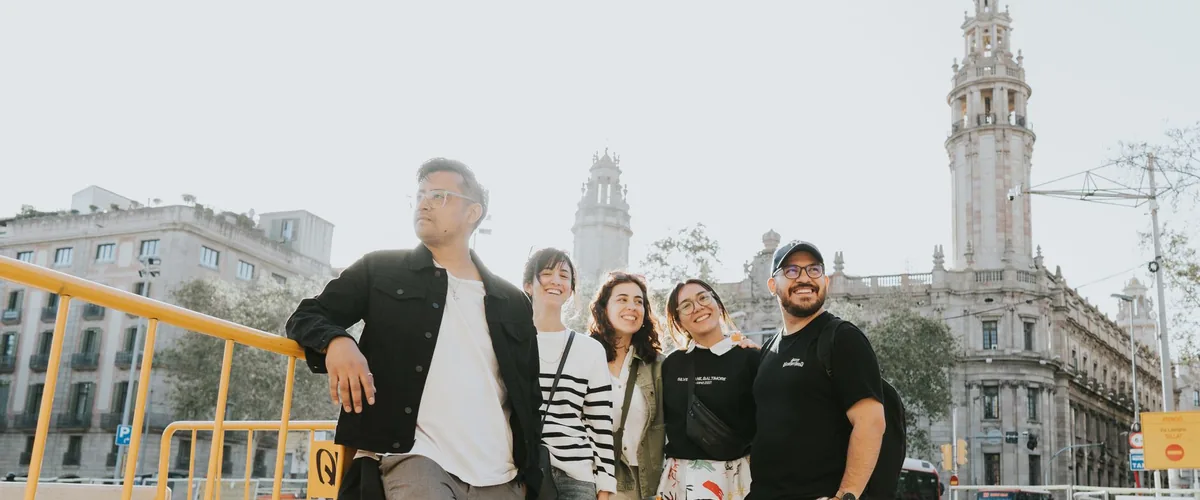

Planning a school trip to Barcelona is mostly not about Barcelona. It is about permission slips, a coach that can park near Park Güell, and knowing which museum will take 28 fifteen-year-olds at 10am on a Tuesday in March. The sightseeing part takes an afternoon to plan. The logistics take months.
This is the checklist version: what to book and when, the paperwork that trips people up, how to move a large group around the city, and a four-day itinerary that holds up with actual students rather than the imaginary ones in a brochure.
Start with the calendar, not the itinerary
The single biggest cause of a stressful school trip is booking the fun parts before the boring parts. Accommodation that takes minors and timed entry to the big sights are the scarce items, and both run out earlier than teachers expect.
| When | What has to be done |
|---|---|
| 6+ months out | School approval and dates. Accommodation held. Flights or rail booked. Rough per-student cost sent to parents, with a deposit deadline. |
| 3 months out | Timed tickets for the big sights. Group travel cards ordered. Insurance confirmed. Consent forms and medical information collected. Passport and health card check. |
| 1 month out | Final headcount and rooming list. Day-by-day plan shared with staff, students and parents. Dietary requirements passed to the hotel. Emergency contact sheet printed, not only stored on a phone. |
| The week before | Briefing with students on rules, meeting points and what to do if separated. Reconfirm every booking by email. |
The passport check three months out matters more than it sounds. Every group discovers at least one expired document, and renewal times are not something you can rush from a staff room.

The paperwork nobody warns you about
Consent forms are the obvious one. The less obvious items are the ones that surface at a hospital desk or a border:
- Medical and dietary information for every student, held by two members of staff, on paper as well as on a phone.
- European health cards where your country issues them, plus travel insurance that explicitly covers a school group and the activities you have planned.
- Parental authorization for a minor traveling without parents. Some countries expect a signed letter, and the requirement depends on your students’ nationalities rather than on Spain. Check with your own authorities, not with the hotel.
- Supervision ratio. Your school’s policy sets this, and many settle around one adult per ten students for a city trip. Decide it early, because it determines how many staff places you are funding.
- A written risk assessment covering transport, free time, and what happens if a student is separated from the group.
Give one member of staff the folder and make them the person who carries it. Shared responsibility for documents means nobody has them at the moment they are needed.
Accommodation that will actually take a school group
Plenty of Barcelona hotels quietly decline groups of minors, and finding this out in April for a May trip is a bad afternoon. Ask three questions before you get attached to a place: do you accept school groups with students under 18, can you give us rooms on the same floor or in the same wing, and do you provide free staff rooms at a group size like ours.
Look at youth hostels with private multi-bed rooms, residence-style accommodation, and hotels in Eixample. Eixample is worth the small premium for one reason: it is a grid, it is flat, and it is walkable to more than you would think, which cuts the number of times you move 28 people through a metro turnstile. Our notes on finding good accommodation apply here, with the group constraints layered on top.
Avoid the beach end of town for a school group. It looks appealing in the photos and it puts your students a long way from everything you plan to visit, with a nightlife strip between them and the hotel door.
Moving 25 students around Barcelona
The metro is the right answer for most days. It is quick, it is cheap, and Barcelona sells multi-person travel cards that a whole group can share by passing the card back through the barrier, which is far less painful than issuing 28 individual tickets. Check the current card types and prices on the TMB site before you order.
Three practical rules that make the difference between a smooth day and a headcount panic:
- Name the next meeting point before you enter the station, not after. If the group splits across two trains, everyone already knows where to stand.
- Put a staff member at the front and at the back, and never let the group stretch past a full carriage.
- Count at every transition. Out of the hotel, into the station, out of the station, into the site. It takes fifteen seconds and it catches the problem while it is still fixable.
Book a private coach for the Montserrat day and for the airport transfers only. A coach in the city center is slower than the metro and gets stuck in exactly the places you want to visit.
A four-day itinerary that works with students
The mistake in most school itineraries is density. Four sights a day looks efficient on paper and produces a group that has stopped listening by lunch. Two anchors a day, with real gaps, gets you better attention and fewer problems.
Day 1: arrival and the Gothic Quarter. Land, drop bags, eat, then walk. The old town is free, it orients everyone, and it burns off the travel restlessness. Finish at the cathedral and set the rules for the week while everyone is still tired enough to listen.
Day 2: Sagrada Família and Eixample. Book the earliest slot you can get. The official site handles group bookings and school rates through its own channel, and the audio guide holds attention better than a teacher competing with the acoustics. Spend the afternoon on Passeig de Gràcia looking at the Modernista facades from the street, which costs nothing and covers the same syllabus.
Day 3: Park Güell and the harbour. Timed entry again, booked in advance, and go in the morning before the heat. The monumental zone is small, so an hour inside is enough. Afternoon down at Barceloneta and the harbour front, with a long break. This is the day to schedule supervised free time in a defined area, because the group needs it by day three and the seafront is easy to police.
Day 4: Montserrat or a museum morning. Montserrat is the strongest day trip: an hour out of the city, a mountain, a monastery, and a rack railway that students remember longer than any gallery. It needs a coach and most of the day. If the weather is against you, swap in the Picasso Museum or the maritime museum and a proper sit-down lunch, which does more for a group at the end of a trip than one more monument. Our guide to eating well on a trip is useful when you are feeding 30 people on a schedule.
Leave one afternoon genuinely empty. It absorbs the delays that will happen, and if nothing goes wrong you have an unplanned afternoon in Barcelona, which no student has ever complained about.
What it costs per student
Prices move every year, so treat the shape of this rather than the numbers as the guide. The reliable pattern is that transport and accommodation dominate, entries are smaller than people fear, and food is the line item that quietly doubles if you leave it unplanned.
- Getting there: usually the largest single item, and the one most affected by travel dates. Term-time midweek is cheaper than a holiday weekend by a wide margin.
- Accommodation: per night per student, in a shared room, for three or four nights.
- Local transport: modest with a multi-person travel card. Budget separately for the Montserrat coach.
- Entries: two or three paid sights, at group and student rates, which are meaningfully lower than the public price.
- Food: decide the model in advance. Breakfast at the hotel, a fixed lunch allowance and a booked group dinner is easier to control than handing out cash and hoping.
- Contingency: a real one, per student, for the taxi to the clinic and the replacement train ticket.
Publish the total to parents once, with the deposit and final payment dates, and do not revise it upward later unless something outside your control forces it. The general principles in traveling as a group hold here, and tipping conventions differ from home, so tipping in Europe is worth a look before the group dinner.
Safety and the rules you set on day one
Set the rules once, on the first evening, in plain terms. Five is enough: stay in threes, never alone. Phones charged and on. This is the meeting point if we are separated. These are the streets you may use in free time. This is the time you are back at the hotel.
Give every student a card with the hotel address in Spanish, both staff phone numbers, and the European emergency number 112. Paper works when a phone is dead or stolen, which is the exact moment it is needed. Pickpocketing is the realistic risk in Barcelona rather than anything more serious, and it concentrates on Las Ramblas, the metro, and crowded sights. Bags in front, phones away while walking, and nothing valuable in a back pocket.
Agree with your staff who is doing the night check and how, and make sure someone stays contactable through the night. That is the arrangement you will be asked about afterwards if anything happens.
Put the whole plan somewhere everyone can see it
The version of this trip that runs smoothly is the one where the students, the other staff and the parents are all looking at the same schedule. A printout goes out of date the moment a booking shifts, and a group chat buries the detail under conversation.
Build the four days as one itinerary in Lentii, with each day’s timings, addresses and meeting points attached, then share the link with your colleagues and the parent group. If Montserrat moves to Thursday, everyone sees Thursday. If you are still choosing between Barcelona and somewhere else, our comparison of the best cities for study trips in Europe is the place to start, and the practical side of planning group trips covers the mechanics for any destination.
FAQ
How many days do you need for a school trip to Barcelona?
Four days and three nights is the practical minimum that includes a day trip, and five days is comfortable. Three days works if you skip Montserrat, though arrival and departure eat most of two of them.
When is the best time of year to take a school group to Barcelona?
Spring and autumn. April to early June and late September through October give you walkable temperatures and lower prices than summer. July and August combine heat with the heaviest crowds at every sight you have booked, which is hard work with a large group.
Do we need to book Sagrada Família and Park Güell in advance for a school group?
Yes. Both use timed entry and both have separate group and educational booking channels with reduced rates. Book them as soon as your dates are confirmed, because morning slots go first and a group cannot improvise its way in on the day.